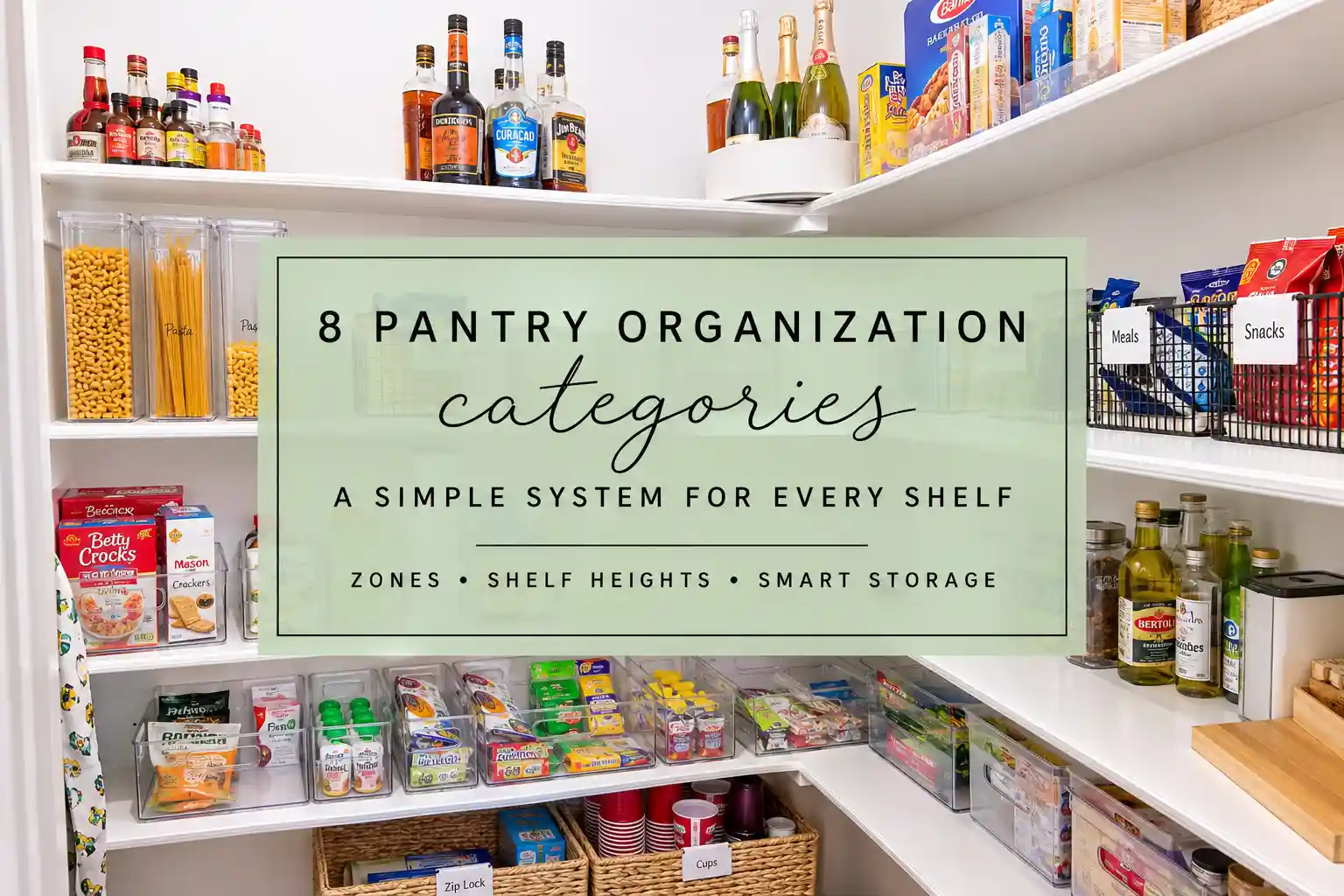
Eight simple pantry categories for a more organized, functional space.
Pantry organization categories are groups of similar foods, such as breakfast, baking, canned goods, and snacks, that each get a permanent spot on your shelves. Sort into categories before you buy any bins. You'll see how much space each group needs, and you'll find the duplicates you already own.
This guide covers eight categories, where each one fits on a shelf, which foods are worth decanting, a six-step setup, and a free printable label and inventory set. It is built for shallow reach-in pantries, and the same zones scale up to a walk-in.
Time: about 20 to 30 minutes for a small pantry. You'll need: counter or table space, a trash bag for expired food, a tape measure, a damp cloth, and our free printable pantry labels (or masking tape and a marker). Bins are optional.
In this guide Explore sections
- What are the best categories for pantry organization?
- The 8 pantry categories in detail
- Where each category belongs: the shelf-height map
- Decant or leave it? The Findable Home Decanting Matrix
- Food safety and freshness rules for dry goods
- Download the free printable pantry labels and inventory sheet
- Frequently asked questions
- How to set up your pantry zones, step by step
What Are the Best Categories for Pantry Organization?
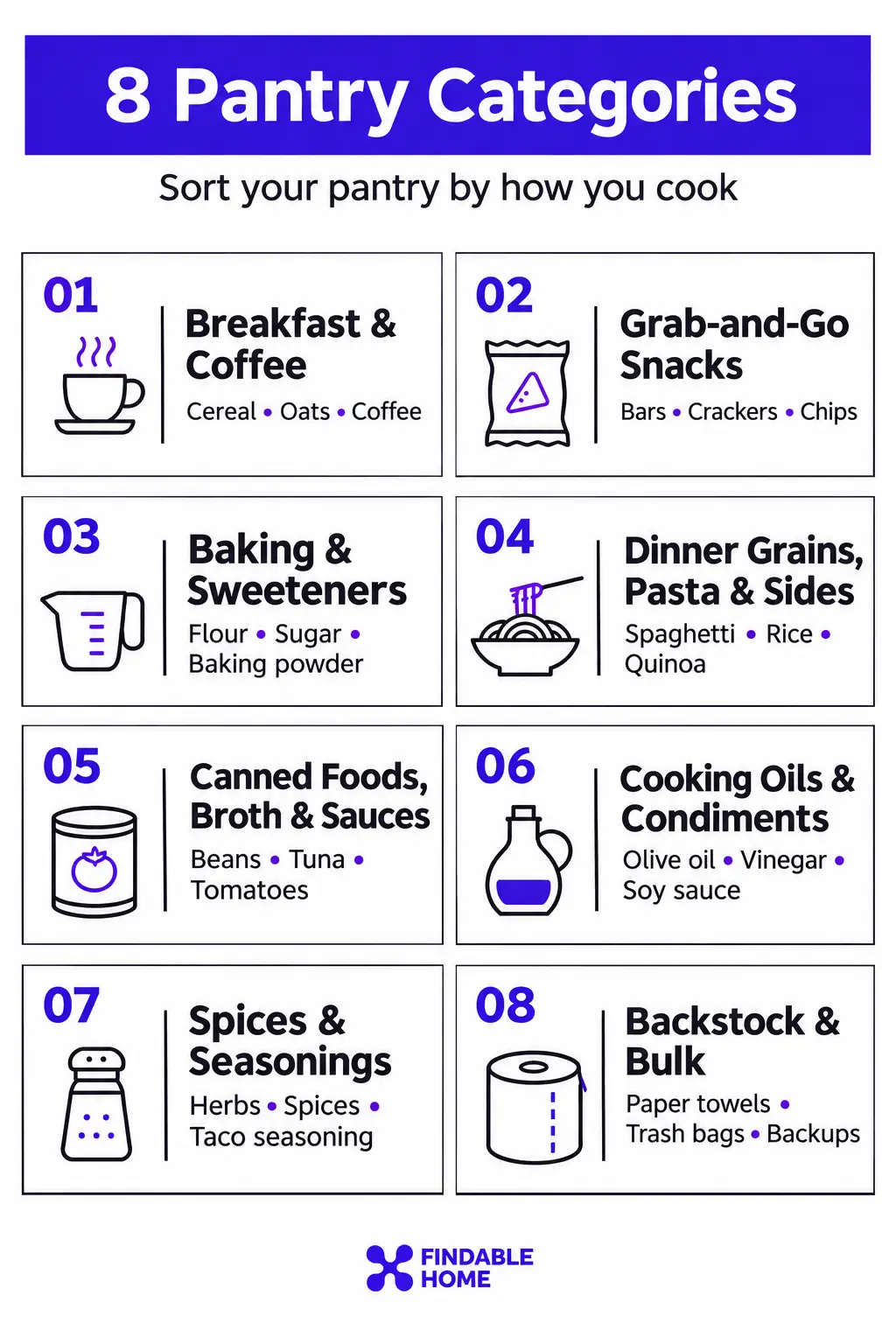
The most practical pantry categories follow how you cook and eat: breakfast, baking, dinner staples, canned goods, oils and condiments, snacks, spices, and backstock. Each group lives in one place, so you can see what you own and put groceries away without thinking about it.
The 8 categories:
- Breakfast and Coffee: cereal, rolled oats, pancake mix, coffee, tea, honey.
- Baking and Sweeteners: flour, granulated and brown sugar, baking powder, cocoa, chocolate chips.
- Dinner Grains, Pasta and Sides: spaghetti, penne, rice, quinoa, lentils, breadcrumbs.
- Canned Proteins, Broths and Sauces: canned beans, tuna, diced tomatoes, pasta sauce, coconut milk, chicken stock.
- Cooking Oils, Vinegars and Condiments: olive and vegetable oil, vinegars, soy sauce, hot sauce, nut butters.
- Grab-and-Go Snacks: granola bars, crackers, pretzels, tortilla chips, trail mix, dried fruit.
- Spices, Seasonings and Packet Mixes: dried herbs, ground spices, salt, taco seasoning, gravy packets.
- Backstock and Bulk Overflow: paper towels, trash bags, bulk drinks, unopened backups of staples.
The 8 Pantry Categories in Detail
Measure before you buy anything. Many reach-in pantry shelves are shallow, often somewhere around 10 to 12 inches deep, so a 14-inch bin can overhang the front edge and keep the door from closing. Measure the usable shelf depth and the opening width, then compare both to any container you're considering.
Everything below sits on a shelf or the floor, so none of it needs drilling. The one exception is the door rack in category 7, which depends on your door and your lease.
1. Breakfast and Coffee
- What goes in: cereal boxes, rolled oats, instant oatmeal packets, granola, pancake mix, coffee or pods, tea, syrup.
- Containers: A shoebox or a cut-down cardboard box corrals loose oatmeal and granola pouches, and tall cereal boxes stand beside it. If you buy a bin, pick a shallow open-front one and check its depth against your shelf.
- Small-pantry tip: With only three shelves, move coffee and tea to the counter by the kettle and share one shelf between breakfast items and snacks.
2. Baking and Sweeteners
- What goes in: all-purpose and bread flour, white, brown, and powdered sugar, baking soda, baking powder, yeast, vanilla, baking chocolate.
- Containers: Flour and sugar bags tear and spill, so these are the items most worth moving into airtight canisters. Look for a silicone gasket and a square shape that stacks well. A clay brown-sugar saver can help keep brown sugar soft. Small extracts fit in a narrow caddy or a mug.
- Small-pantry tip: If you bake less often than you cook dinner, baking doesn't need prime space. Put light items (extracts, baking powder, chocolate chips) on a higher shelf, and keep heavy flour and sugar canisters at waist height, where they are safer to lift.
3. Dinner Grains, Pasta and Sides
- What goes in: spaghetti, macaroni, lasagna noodles, jasmine and basmati rice, quinoa, couscous, dry beans, boxed mac and cheese.
- Containers: Stand boxed pasta upright like books in a deep bin with handles, so the whole group slides out like a drawer. Check the bin's depth against your shelf before you buy one.
- Small-pantry tip: Keep the box for specialty or whole-grain pasta, because the cook time is printed on it. For anything you decant, cut out the instructions and tape them inside the container lid.
4. Canned Proteins, Broths and Sauces
- What goes in: black beans, chickpeas, canned tuna and salmon, crushed tomatoes, jarred pasta sauce, curry paste, cartons of broth.
- Containers: A tiered shelf riser lets you read back-row labels without moving the front cans. Check that its depth and height fit your shelf, and that it doesn't leave too little clearance above the top row. Without a riser, line cans up front to back by type, labels facing out, oldest at the front.
- Small-pantry tip: Stack identical cans in one front-to-back row instead of spreading them across the front of the shelf.
5. Cooking Oils, Vinegars and Condiments
- What goes in: olive, avocado, and vegetable oil, balsamic and white wine vinegar, soy sauce, sesame oil, mustard, backup ketchup, nut butters, unopened dressings.
- Containers: A turntable with a raised lip keeps tall bottles from tipping in a corner. Confirm the diameter fits inside your shelf depth. A rimmed baking sheet or tray does the same job for free by keeping bottles together and catching drips.
- Small-pantry tip: Keep a small everyday bottle of oil within reach of the stove, but not beside it, and store backup bottles in the pantry. Heat and light shorten oil's shelf life (see the food safety rules below).
6. Grab-and-Go Snacks
- What goes in: protein bars, fruit pouches, rice cakes, pretzels, chips, nuts, popcorn kernels, cookies.
- Containers: Two open-top baskets or shallow boxes, one for salty snacks and one for sweet, let anyone grab a snack without pulling down the whole group.
- Small-pantry tip: Unbox granola bars and fruit pouches as you unpack groceries and toss the outer cardboard. The wrappers take up less shelf space than the boxes.
7. Spices, Seasonings and Packet Mixes
- What goes in: everyday spice jars (garlic powder, cumin, paprika, cinnamon), bouillon cubes, taco seasoning packets, ranch dip mix, bay leaves.
- Containers: Jars line up on a tiered spice riser, and flat packets stand upright in a small box or a divided bin.
- Small-pantry tip: Moving jars and packets to the back of the door frees shelf depth. Our pantry door storage ideas cover the options. Renters should check three things first: whether the door still closes with the rack loaded, the rack's stated weight limit, and your lease if the rack mounts with screws or adhesive. Racks that hang over the door need no screws or adhesive, but they can still stop a door from closing, so test one with a full load.
8. Backstock and Bulk Overflow
- What goes in: extra paper towels, trash bags, cases of sparkling water, unopened backups of cereal or snacks, seldom-used roasting pans.
- Containers: A floor basket or a labeled box keeps bulk packs together and off your main shelves.
- Small-pantry tip: Keep unopened backups out of the prime zones. Paper towels and trash bags can go on the top shelf or in a hallway closet.
Where Each Category Belongs: The Shelf-Height Map
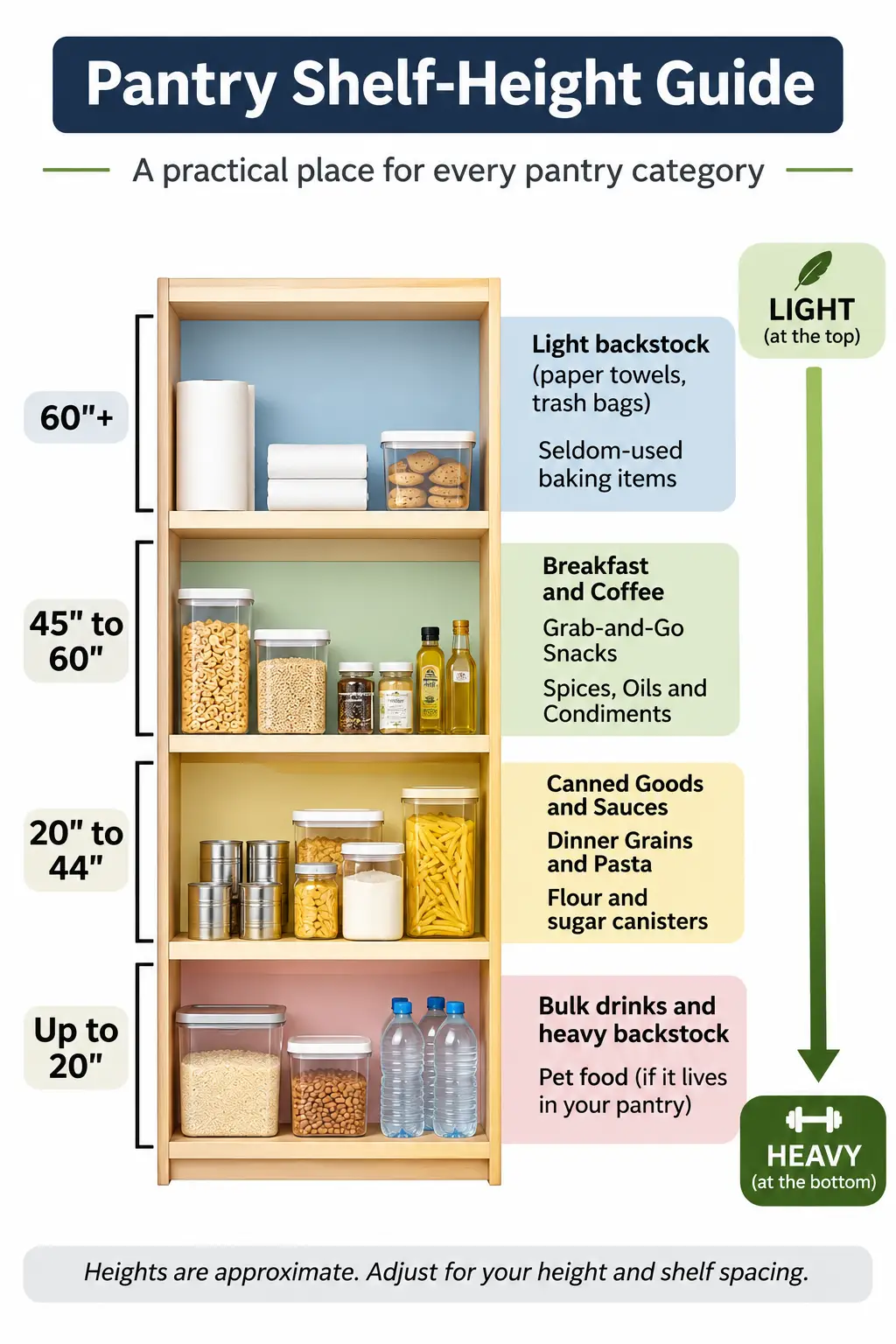
Heavy cans on an overhead shelf are easy to drop, and daily snacks on the floor are a pain to reach. Match each category to a height:
| Shelf level | Approx. height from floor | Categories | Why it works |
|---|---|---|---|
| Top shelf | About 60" and up | Light backstock (paper towels, trash bags), seldom-used baking items | Light, rarely used items stay out of the way, and nothing heavy sits overhead. |
| Eye to chest | About 45" to 60" | Breakfast and Coffee, Grab-and-Go Snacks, Spices, Oils and Condiments | The things you reach for daily sit in your line of sight. |
| Waist to knee | About 20" to 44" | Canned Goods and Sauces, Dinner Grains and Pasta, flour and sugar canisters | Cans, glass jars, and 5-pound canisters are safest to lift at this height. |
| Floor | Up to about 20" | Bulk drinks and heavy backstock (and pet food, if it lives in your pantry) | Heavy cases rest on the floor instead of bowing the shelves. |
These ranges are approximate. Adjust them to your height and your shelf spacing. If your shelves are thin wire racks that bow under weight, put the heaviest items on the lowest shelf or the floor.
Decant or Leave It? The Findable Home Decanting Matrix
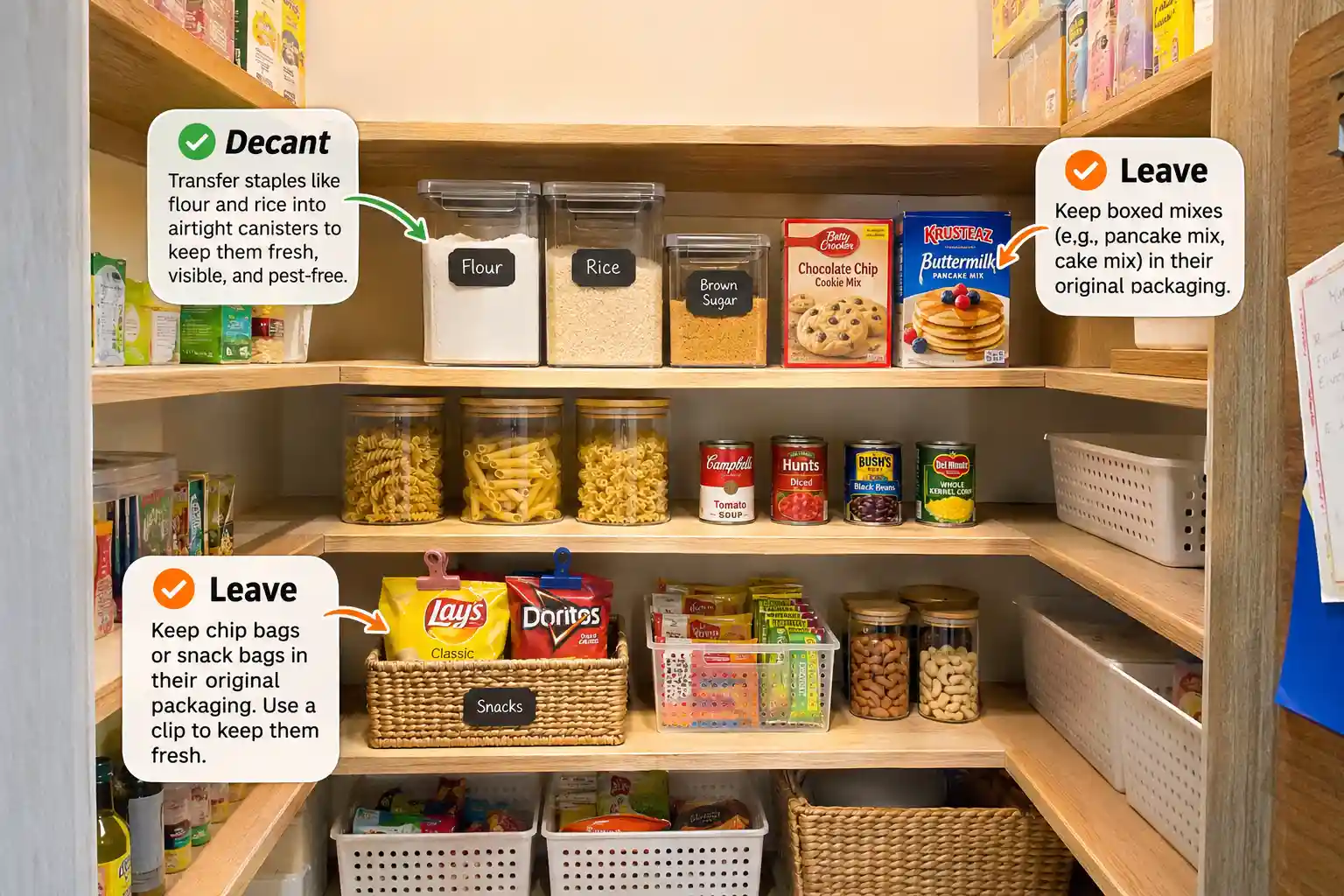
Social media pushes the idea that every pantry item belongs in a matching acrylic jar. Decanting everything costs a lot, adds dishwashing, and can leave you guessing how long to boil a specialty pasta after the box is gone. A more realistic approach to pantry organization is to decant only what benefits from it.
| Item | Decant? | Why |
|---|---|---|
| Flour and whole grains | Yes | Paper bags tear, and pantry pests can get into packaged flour and grains. An airtight lid helps keep them out. |
| Brown and white sugar | Yes | An airtight lid keeps brown sugar from hardening and helps keep ants out of loose flaps. |
| Bulk rice and rolled oats | Yes, if you buy big bags | Large floppy bags spill on narrow shelves, and square canisters stack. |
| Daily cold cereal | Optional | Airtight lids can help keep cereal crisp in humid climates. |
| Boxed baking mixes | No | The box lists liquid ratios and oven temperatures. |
| Specialty or whole-grain pasta | No | The cook time is printed on the box. |
| Store-bought jars and cans | No | They are already sealed. |
| Chips and crackers you finish within days | No | A bag clip is enough. |
| Individually wrapped bars and pouches | Unbox only | Toss the outer box and keep the wrapped bars in an open basket. |
If you decant, copy the best-by date from the original package onto the container label. Decanting removes the date, and you'll want it for the first-in, first-out rotation below. Finish what's in a canister before you refill it, so old and new product don't mix.
Food Safety and Freshness Rules for Dry Goods
A tidy pantry doesn't help if food spoils before you cook it. Four rules:
- First in, first out (FIFO): When you unpack groceries, slide new cans, cartons, and boxes behind the older ones, so you use the oldest dates first.
- Keep oils, nuts, and whole-grain flours away from heat and light: Their natural fats can turn rancid faster in warm or bright spots. Store them on a cool middle or lower shelf, away from the oven, the stove, and direct sun.
- Keep the date: Write the best-by date on any container you refill, since decanting removes the original label.
- Check shelf lives: Even sealed staples don't last forever. The USDA FoodKeeper lists storage times for pantry staples, canned goods, and baking ingredients.
Download the Free Printable Pantry Labels and Inventory Sheet
Labels tell everyone in your home where groceries go when they unpack the bags. A label on the front of each zone keeps snacks out of the baking zone. Print ours, or use masking tape and a marker.
- What you get: category labels for all 8 zones, blank labels for your own zones (gluten-free, kids' lunchbox, dog treats), and a one-page pantry inventory and expiration tracker to clip inside the pantry door.
- Where to get it: It's free, and it's hosted on our Buy Me a Coffee shop.
- Printing tip: Plain paper in a label holder or under clear tape works. Matte waterproof sticker paper wipes clean, but test removal on one bin first, since adhesive can leave residue on some plastics.
- Who it's for: renters and homeowners who want labeled shelves without buying a label maker. Nothing attaches to your walls.
Get the free labels and inventory sheet on Buy Me a Coffee
Frequently Asked Questions About Pantry Categories
How many categories should a small pantry have?
Five or six is a practical target for a small apartment or reach-in pantry, rather than ten or more micro-zones. Merge related groups onto shared shelves. For example, put Breakfast and Grab-and-Go Snacks on one shelf, and combine Grains, Pasta, and Canned Goods into a single dinner staples zone.
Do I need to buy bins before I sort my pantry into categories?
No. Sort first, measure your shelves, and use boxes, trays, or what you already own for a week. If one group keeps spilling or sliding, that tells you what kind of container to buy, and what size.
Should canned goods and dry pasta share a shelf?
They can, if the shelf is sturdy and at waist height, since you often cook with both. If your pantry has thin wire racks that bow under weight, keep heavy cans and glass jars on the lowest shelf and lighter pasta boxes higher up.
How do I keep pantry categories organized long-term?
Use each bin or shelf section as a fixed boundary, and run a 3-minute reset before you write your grocery list. When the snack bin is full, wait to buy more snacks until there's room, and keep labels on the front so everyone returns items to the right spot.
How to Set Up Your Pantry Zones, Step by Step
- Clear and purge. Pull everything onto the counter or table, throw out expired or stale food, and wipe the shelves.
- Measure. Write down each shelf's depth, the opening width, and the space between shelves. Note which shelves are sturdy and which bow.
- Group. Sort the food into the 8 categories, or into 5 or 6 if your pantry is small.
- Map to shelves. Put heavy items at waist height, daily items at eye level, and rarely used items at the top and bottom.
- Label. Print our free labels, or use masking tape and a marker or a label maker, and mark each zone. A label on the front of each zone keeps snacks out of the baking zone.
- Reset weekly. Before each grocery list, spend 3 minutes returning strays to their zones.
How We Put This Guide Together
We evaluated these pantry storage options based on their dimensions, materials, design, storage capacity, accessibility, and suitability for different pantry layouts. We also considered manufacturer specifications, product features, and practical factors such as shelf clearance, ease of access, and available space.
Our selections prioritize products that address specific pantry organization needs, with attention to fit, functionality, and everyday convenience. Before purchasing, compare the listed dimensions with your available shelf space and check the latest product details.
Final thought
A well-organized pantry starts with understanding what you store, how often you use it, and which solutions make everyday items easier to find. Choosing the right storage solutions for your needs becomes much easier when you understand the different pantry organization categories.